

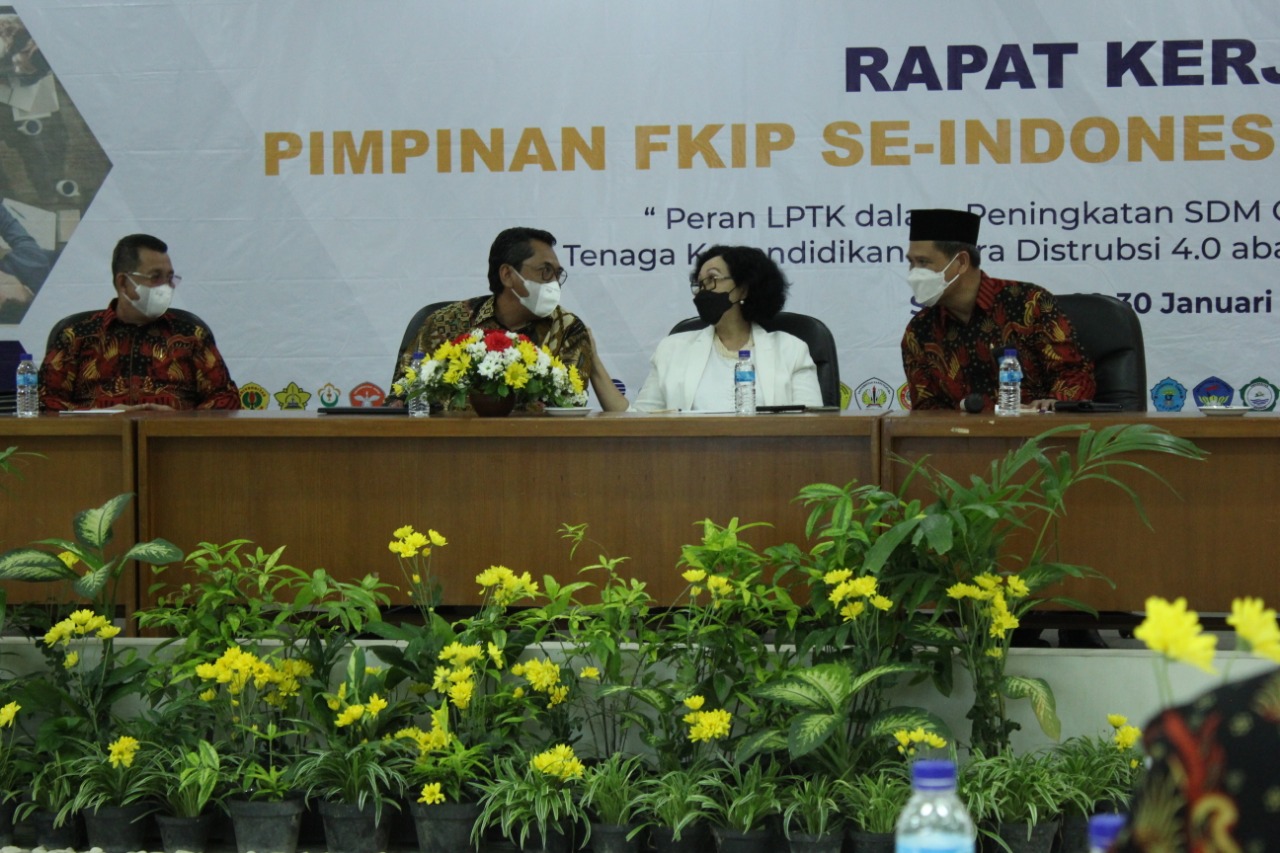
FKIP – Leaders of State Teaching and Educational Faculties (FKIP) throughout Indonesia held a work meeting agenda with the theme “The Role of LPTKs in Improving Human Resources for Teachers and Education Personnel in the Era of Disruption 4.0 in the 21st Century”. This activity was carried out offline at UNS Inn on Saturday (29/1/2022).
The Working Meeting of State FKIP Leaders throughout Indonesia also discussed material on the issue of the strategy for implementing the Teacher Professional Education (PPG) program. The material was delivered by the Director of PPG, Temu Ismail, S.Pd., M.Sc. and moderated by Dr. AG. Tamrin., M.Si.

Meet Ismail, S.Pd., M.Sc. convey the legal basis for teacher or educator certification as regulated in Law on Teachers and Lecturers no. 14 of 2005, PP No. 19 of 2017, Permenristekdikti No. 55 of 2017, and Permendikbud No. 38 of 2020.
“It is contained in the Law on Teachers and Lecturers No. 14 of 2005 which is mandated in several ways related to the professionalism of teachers which is a form of professional work, so that it is required by several requirements ranging from academic qualifications, competence, and of course legality in terms of professionalism is related to educator certificates,” he explained.
Temu Ismail then conveyed about PPG’s achievements in office for five years from 2017 to 2021, the process of implementing PPG in positions, the development of the Teacher Profession Program Student Competency Examination (UKMPPG), various obstacles in implementing PPG, the direction of PPG design policies, to the main framework for teacher transformation. and Education Personnel (GTK).
Furthermore, Temu said that there are several things that need to be done in improving the implementation of PPG in future positions, namely the need for lecturer guidance when studying independently, maximizing HOTS exploration in material deepening, the need for additional time for students to practice, the need for intensifying the implementation of follow-up assessments, and the need for affirmation regarding the development of problem-based teaching materials.
“That there really needs to be a lecturer’s guidance when studying independently in the initial process, maybe now each one is learning to explore their respective material but there is no communication between candidates or students and lecturers,” he explained.
Temu said that there were five main programs of the Directorate General of GTK to support the policies of the Ministry of Education, Culture, Research, and Technology (Kemendikbudristek). Meanwhile, the programs are in the form of Transformation of Educational Leadership, Transformation of Pre-service PPG, Development of Teacher Learning Ecosystems in each Province, Empowerment of Educational Communities, and Student-centered Regulation and Governance of GTK HR.
“This second policy is what we are currently developing to get a scheme mechanism for the pre-service PPG in particular,” he said.
In the final session, Temu delivered four pre-service PPG outputs, namely pre-service graduates are professional teachers, graduate profiles have the same capacity that applies nationally, teachers need meaningful learning experiences, and need to be closer to the school world.
“What we hope is that the PPG Pre-Office will produce graduates who are novice professional teachers as a basis for developing a sustainable profession, have the same capacity applied nationally, have a meaningful learning experience because of the tendency to imitate what has been experienced, and need to be closer to the school world. ,” he explained.
Reporter: Muhammad Muzaqqi
Editor: Zalfaa Azalia Pursita
https://fkip.uns.ac.id/
https://www.instagram.com/fkipuns.official/
#fkipuns
#fkipbagus
#uns
#universitassebelasmaret
#unsbisa
