

FKIP – During the Covid 19 pandemic, students studied at home and showed learning loss. In addition, they also experience lagging in achieving the learning objectives that have been set in the curriculum. Therefore, the Special Education Study Program (Prodi) Service Team (PLB) Faculty of Teacher Training and Education (FKIP) Sebelas Maret University (UNS) held a Digital Class Assistance activity for Grade 5 Students at SD Negeri 1 Wadunggetas, Wonosari, Klaten on 28 June to 14 July 2022.
The PLB FKIP UNS Study Program Service Team consists of 3 members, namely Mohammad Anwar, M.Pd, Dr. Supriyadi, M.Pd, and Tias Martika, M.Pd. They assist in conducting Minimum Competency Assessment (AKM) exercises or simulations through the official website of the Educational Assessment Center (pusmendik.kemdikbud.go.id). This activity was held for 10 meetings.
Contacted by the team of journalists from fkip.uns.ac.id, Mohammad Anwar, M.Pd. said that this mentoring activity was aimed at supporting the government’s policy of mapping and continuous improvement of the quality of the education system as stated in Permendikbudristek Number 17 of 2021 concerning the National Assessment-Minimum Competency Assessment (AN AKM).
“The mentoring activity is carried out to improve the reading literacy and numeracy literacy skills of fifth-grade elementary school students through online AKM application simulations on the Let’s Try AKM PUSMENDIK menu. This is important, because during the Covid 19 pandemic, students experienced learning loss, especially in the aspect of reading and numeracy skills. Both literacy skills will be measured through AKM. In addition, this activity also aims to provide an initial orientation for elementary school students in operating computers because the majority of children are not familiar with operating computers,” said Anwar.
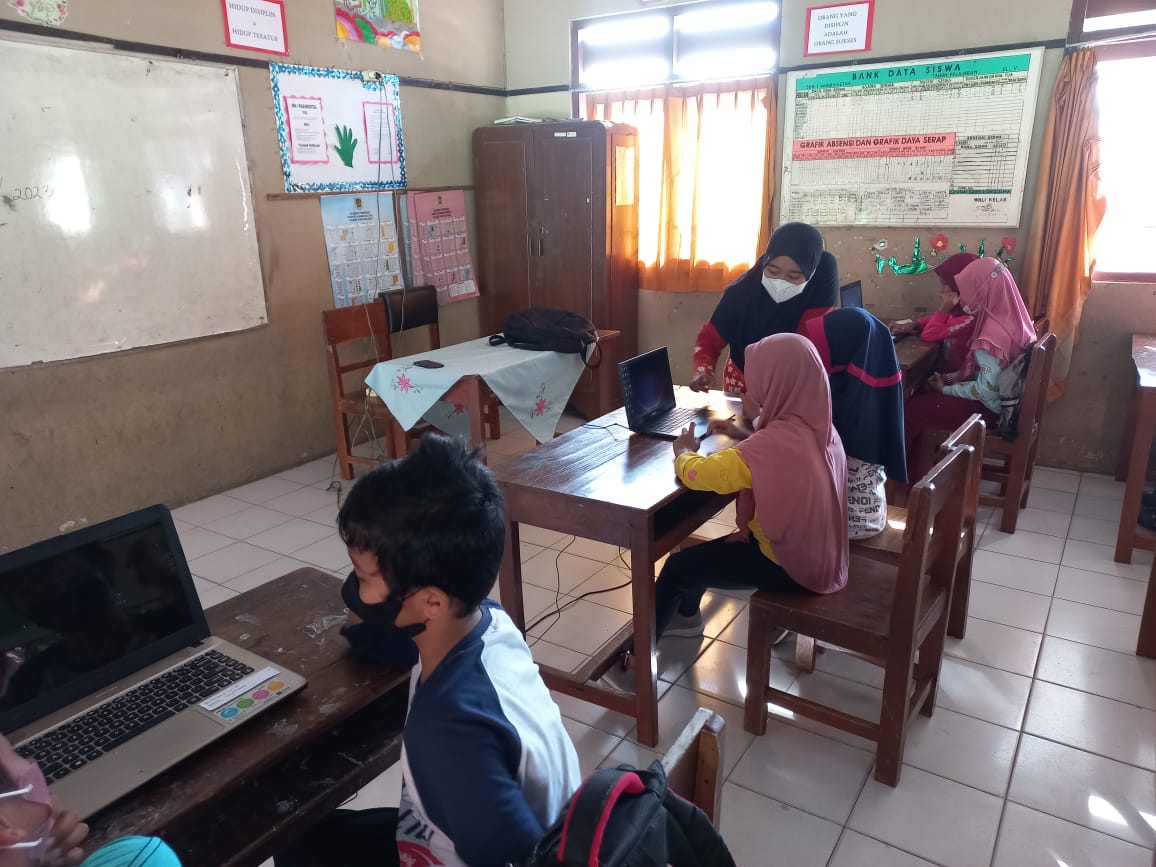
Furthermore, Anwar also explained that the topic of providing AKM training or simulation was motivated by the challenges of the digitalization gap and extraordinary facilities for schools, parents, especially students or students.
“This topic was chosen with the consideration that the implementation of AKM is an extraordinary challenge for the school, parents, especially students or students. In the implementation of AKM, the biggest obstacle is the digital divide because the infrastructure development of each region is different. For the lower-middle-class economy in the village, laptops are a luxury onion, so not many have them. In addition, the internet speed that varies between schools and regions is a problem in itself,” explained Anwar.
Digital class assistance is carried out through 3 stages, namely orientation to use computers because students are not accustomed to using computers, orientation to the Ayo Coba AKM application, and simulation of working on AKM questions. Assistance activities run smoothly and orderly. The results of the evaluation of the AKM simulation at each meeting showed an increase in the reading and numeracy skills of 5th-grade elementary school students. So that mentoring activities can be declared successful and need to be carried out every year.
Public Relations of FKIP
Reporter: Rosantika Utami
Editor: Aulia Anjani
https://fkip.uns.ac.id/
https://instagram.com/fkipuns.official/
#fkipuns
#fkipbagus
#uns
#unsbisa
