

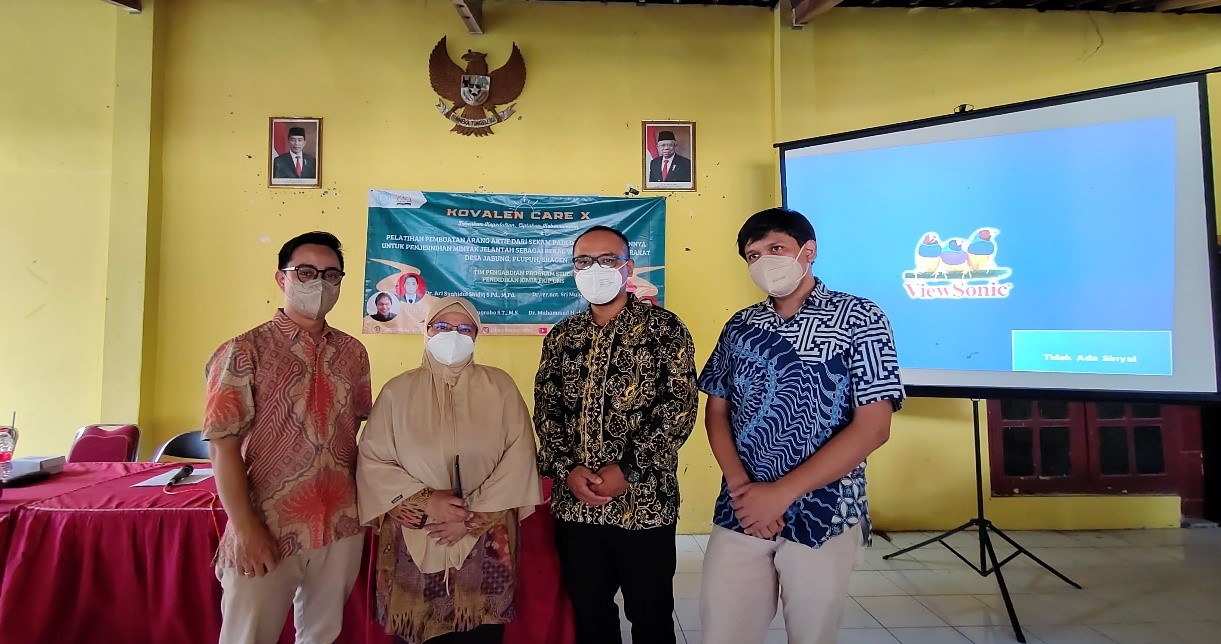
FKIP – Chemistry Education Study Program, Faculty of Teacher Training and Education (FKIP) Universitas Sebelas Maret (UNS) Surakarta in community service activities held direct training in making activated charcoal from rice husks and utilization for used cooking oil to the people of Jabung Village, Plupuh District, Sragen Regency on Monday (4/7/2022). This activity is carried out to utilize and increase the economic value of rice husks and aims to provide for entrepreneurship for the people of Jabung village, Plupuh, Sragen.
The service team is chaired by Dr. rer. nat. Sri Mulyani M.Si. and consists of Dr.rer.nat. Wirawan Ciptonugroho S.T., M.Si., Dr. Muhammad Hizbul Wathon, M.Sc., Dr. Ari Syahidul Shidiq, M. Pd., This training activity was carried out at the Jabung village hall, Plupuh, Sragen. A total of 60 Jabung Village communities participated in the training activities while still complying with applicable health protocols. This training evaluation and follow-up activity were carried out on 02 – 04 July 2022. As a result, based on the results of the training evaluation as many as 32.65% of participants strongly agreed and 55.1% agreed and stated that training activities and assistance of activated charcoal from rice husks and their use for used cooking oil purification were carried out according to the needs of the community.
Activated charcoal is a carbon that has a good absorption ability (adsorbent) to molecules in the form of organic and inorganic compounds, both in the form of solutions and gases. Rice husks contain about 37.5% carbon which can be used as a purifier or adsorbent in the form of activated charcoal. With the abundance of rice husk resources and low economic value and utilization that is still less than rice husks, it is necessary to know by the public that this rice husk can be used as activated charcoal.
The activity in this training began with the presentation of material on the introduction of activated charcoal to understand and provide more knowledge to the people of Jabung village about activated charcoal from rice husks. After that, the activity continued with the presentation of material in the form of selling value and utilization of activated charcoal derived from rice husks. Armed with the previous submission, the public was given more insights related to the marketing of activated charcoal products from rice husks. With the implementation of this training, it is hoped that the desire for entrepreneurship will grow and utilize rice husks for the purification of used cooking oil so that later it can become the capital of the entrepreneurial community.
FKIP public relations
