

HUMAS FKIP – Master Program (S-2) Science Education Faculty of Teacher Training and Education (FKIP) Universitas Sebelas Maret (UNS) Surakarta successfully held the 2022 National Seminar on Science Education (SNPS) on Saturday (15/10/2022). Carrying the theme “Science Learning Dynamics in the Independent Curriculum”, the seminar was held online through the Zoom Meeting application.
The seminar began with remarks by Dr. Sarwanto, S. Pd., M. Si. as Head of Study Program (Kaprodi) S-2 Science Education FKIP UNS. In his speech, he hoped that the participants in this seminar could understand the implementation of science learning in the independent curriculum well. After that, the seminar was opened directly by Prof. Dr. Slamet Subiyantoro, M.Si. as Deputy Dean for Academic, Research, and Student Affairs FKIP UNS. In his speech, Prof. Slamet emphasized the importance of understanding the implementation of science learning in the independent curriculum.
“This seminar was motivated by the change of the 2013 Curriculum to the Independent Curriculum which also influenced the practice of science learning in schools. So there needs to be more information about the dynamics of science learning in the independent curriculum. Therefore, students as prospective teachers also need to be given an understanding regarding the implementation of science learning in a good and correct independent curriculum, “said Prof. Slamet.

Moderated by Dr. Bramastia, M. Pd. as Lecturer of the Master’s Program in Science Education FKIP UNS, the seminar presented 2 speakers. The first resource person is Prof. Drs. I Wayan Subagia, M. App. Sc., Ph. D. He is a Lecturer in the Master’s Program in Natural Sciences Education (IPA) at the Ganesha Education University (Undiksha) Singaraja. In his presentation, he explained the role of the Independent Curriculum in complementing the 2013 Curriculum.
“The implementation of the 2013 Curriculum is still experiencing various problems, such as the quantity of learning material is large, learning is less meaningful, character development is blurry, and learning independence is low. Therefore, an independent curriculum has been prepared that provides solutions in the form of reducing learning materials, improving the quality of learning, building Pancasila character, and increasing the independence of students, “explained Prof. Subagia.

Furthermore, Prof. Subagia also explained the potential of students. He explained that students have potential in the form of body potential, learning potential, and work potential that must be seen with the naked eye and empowered in learning, especially science learning. The potential body consists of the physical body, the mental body, and the causal body. Furthermore, the mental body includes thoughts, emotions, and energy. Then, the causal body includes the soul/spirit/atma.
At the end of his presentation, he emphasized that science learning should focus so that students gain competencies that can be used in everyday life. He also advised students to have a character foundation that contains the values of Pancasila.
“That science learning must focus so that students get competencies that can be used in everyday life. Learning has the aim of obtaining knowledge according to the level of education and using knowledge according to the profession or occupation. Basic education such as calistung must be strengthened because it becomes the foundation for further abilities such as critical thinking skills. Generations with weak basic abilities are vulnerable to the influence of hoaxes. In addition, it is important for students to have a character foundation that contains the values of Pancasila,” said Prof. Subagia.
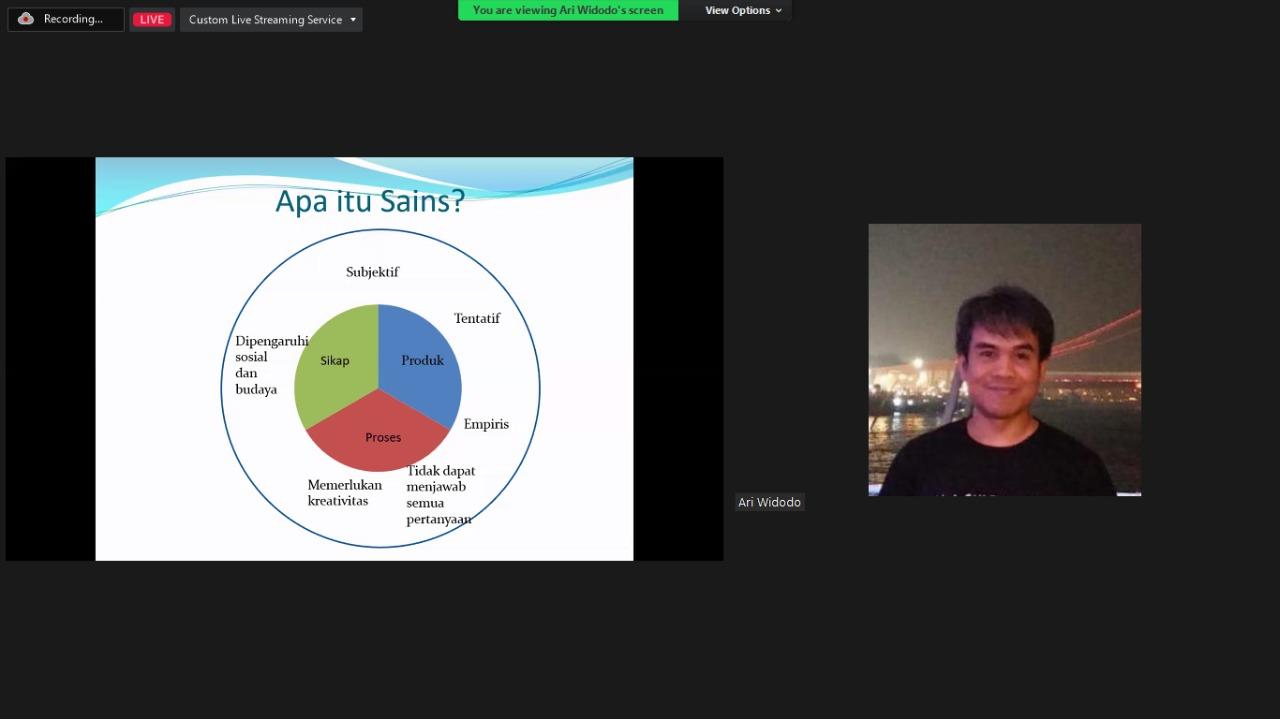
The second speaker is Prof. Dr. H. Ari Widodo, M. Ed. as a Lecturer of Science Education at the Indonesian University of Education (UPI) Bandung. He explained the material on learning outcomes, student profiles of Pancasila, understanding, and process skills. He said that teachers should not only formulate operational learning objectives but should also develop dispositional goals and spiritual goals.
“Currently, teachers usually only formulate operational learning objectives related to learning materials, even though they should also be developed related to dispositional goals and spiritual goals,” said Prof. Ari.
Furthermore, he also explained inquiry learning. He said that science learning is not required by inquiry, but with inquiry, students can better interpret the learning material.
“Inquiry learning that can support science learning in an independent curriculum. The inquiry needs to be done in the form of a project because it takes a long time. Furthermore, the results of the inquiry need to be published and not only limited to the way students make presentations in front of the class but more. Projects in inquiry must produce products in the form of knowledge. Science learning is not required with inquiry, but with inquiry, students can better interpret the learning material.” said Prof. Ari.
.
The activity was followed by a question-and-answer discussion session guided by the moderator. The 2022 SNPS seminar then ended with a joint documentation session.
Reporter: Rosantika Utami
Editor: Aulia Anjani
https://fkip.uns.ac.id/
https://instagram.com/fkipuns.official/
#fkipuns
#fkipbagus
#uns
#unsbisa
