

FKIP – Early Childhood Education Teacher Education Student Association (PG PAUD) Faculty of Teacher Training and Education (FKIP) Sebelas Maret University (UNS) Surakarta held an educational discussion with the theme “The Importance of Financial Literacy for Early Childhood” on Sunday (27/11/2022). The event which was held online through the Zoom Meeting invited Dr. Ratna Candrasari, M.Sc. as a lecturer at the Faculty of Economics, Yogyakarta State University (UNY), and Andriani Rahma Pudyaningtyas, S.Psi., MA as a lecturer at PG PAUD FKIP UNS as speakers.
In his presentation, Dr. Ratna explained that financial literacy is important. The reason for the importance of financial literacy is the fact that the current generation tends to be wasteful, gets bored quickly, gets convenience and comfort in shopping, has financial technology, is susceptible to being influenced by advertisements and idols, has poor financial management skills, and lacks financial literacy information. According to him, these things will later have an impact on increasing financial literacy and increasing financial competence.
“Financial literacy itself is very important, why? That’s one of the emerging skills that children in this century must master besides other basic literacy,” he explained.

Next Dr. Ratna explained financial literacy learning strategies which were divided into three methods, namely for PAUD age (3-5 years), elementary school age (6-12 years), and adolescent age (13-21 years). At the age of PAUD, this is done by activating the executive function, namely the ability to delay gratification for a moment. For elementary school age, using financial socialization strategies or emphasizing the importance of social interaction with parents, teachers, or other adults in shaping children’s character in the form of financial values, norms, attitudes, and habits. Meanwhile, teenagers use financial skill building, so they are no longer limited to knowledge, but they have skills and habits in managing positive finances.
“So there are three methods, for children aged 3-5 years the method is executive function, elementary school age uses financial socialization, then teenagers use _financial skill building,” he explained.
Financial literacy education activities for early childhood in Indonesia have their challenges. According to Andriani Rahma Pudyaningtyas, S.Psi., MA as the second speaker of the culture of society which considers it taboo to talk about money in front of children, the view that financial literacy is not a life skill that must be provided to children, and most schools do not teach children from an early age to managing finances independently are some of the challenges of financial literacy education for early childhood in Indonesia.
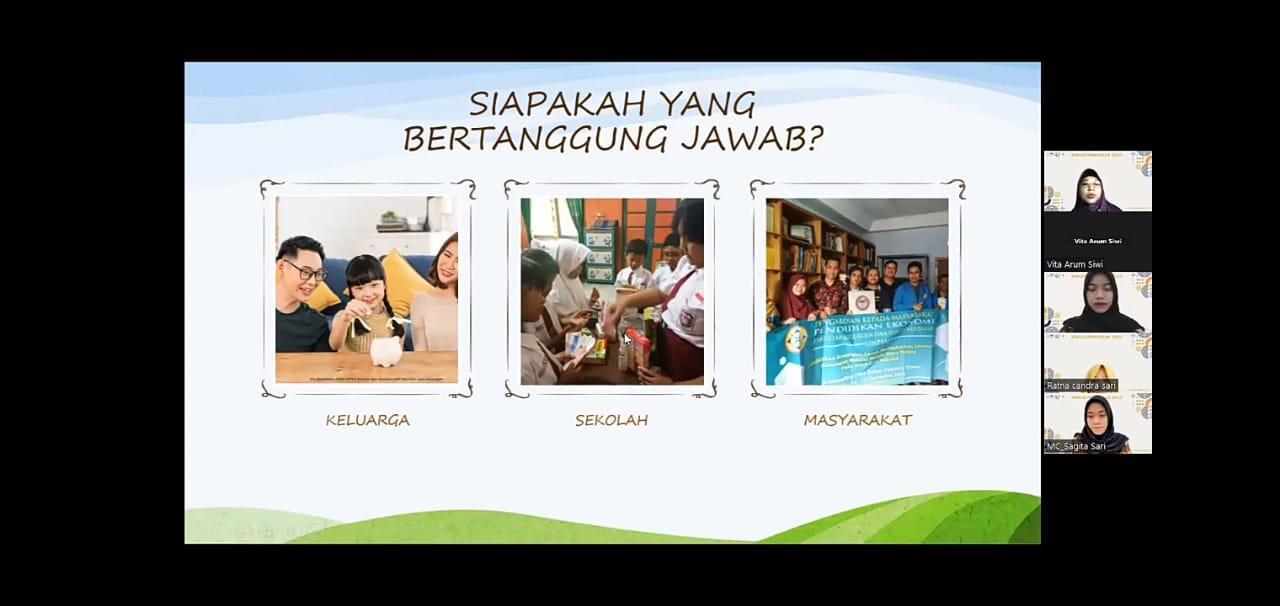
Furthermore, according to Andriani Rahma, several parties are responsible for early childhood financial literacy education. The parties are family, school, and community.
He stated that financial literacy activities in the family can be carried out by introducing activities that generate money, getting used to and giving examples of children to record income and expenses, getting children into the habit of saving, inviting children to play games related to finance, introducing financial applications, reading story books, and teach children to make their financial planning.
The financial literacy activities at schools can be carried out by providing school canteens/cooperatives, incorporating material on the introduction of money in learning activities, organizing entrepreneurship activities, visiting markets, and making visits to financial institutions.
“Financial literacy activities in schools are related to a teacher, meaning that teachers must also have sufficient knowledge about how to manage finances, how to manage finances, how to invest, and so on,” he concluded.
Meanwhile, according to Andriani Rahma, financial literacy activities in the community are carried out through financial education activities with the concept of playing.
“In early childhood, the concept is to play, to play meaningfully, through games that are fun, children will also know or be equipped with these literacy skills,” he added.
HUMAS FKIP
Reporter: Muhammad Muzaqqi
Editor: Aulia Anjani
https://fkip.uns.ac.id/
https://www.instagram.com/fkipuns.official/
#fkipuns
#fkipbagus
#uns
#universitassebelasmaret
#unsbisa
