
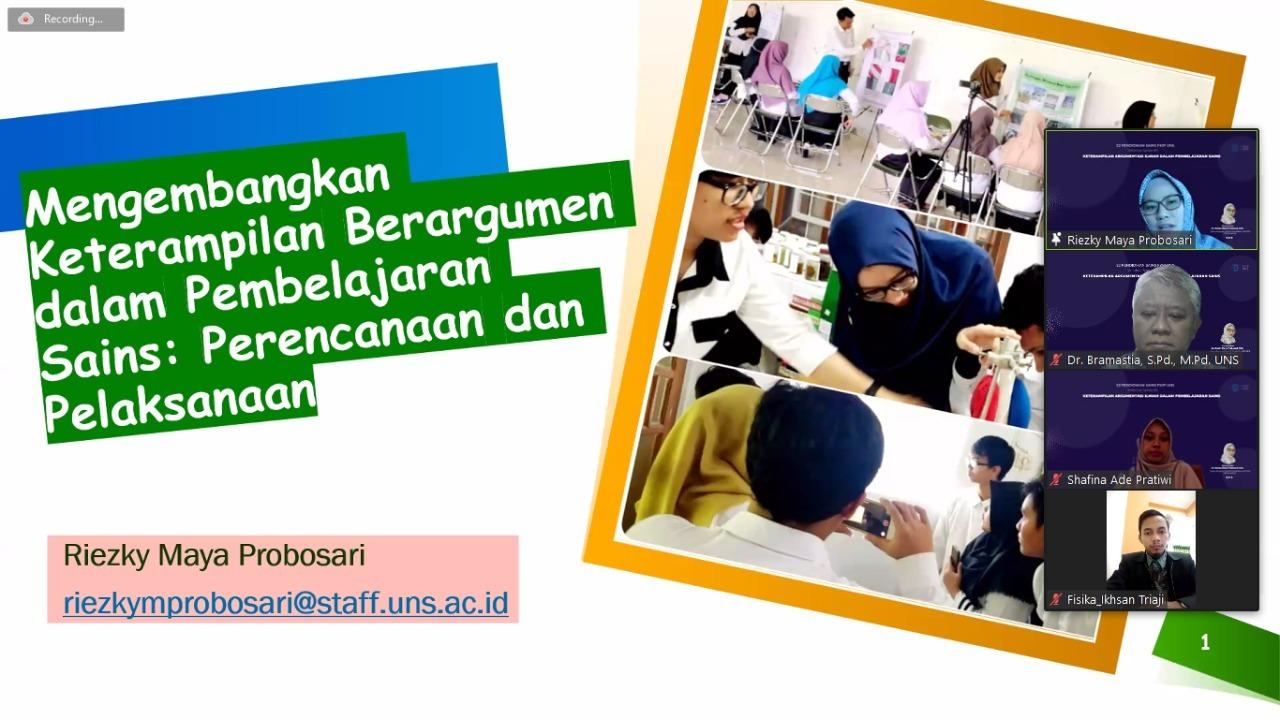
FKIP – Masters (S-2) Science Education Study Program, Faculty of Teacher Training and Education (FKIP) Sebelas Maret University (UNS) Surakarta held a Webinar Series # 5 with the theme “Scientific Argumentation Skills in Science Learning”. This webinar was held on Thursday (29/12/2022) online via the Zoom Meeting application.
The webinar was guided by Hikmah Fatimah a Student of the Master of Science Education Study Program FKIP UNS and was opened directly by Dr. Mohammad Masykuri, M.Sc. as a Lecturer in the S-2 Science Education Study Program FKIP UNS who represented the Head of the Science Education Masters Program (Kaprodi) FKIP UNS, Dr. Sarwanto, S.Pd., M.Sc. In his remarks, he emphasized the importance of scientific and creative abilities in science learning.
“Graduates of the FKIP UNS S-2 Science Education Study Program in the future must have scientific and creative abilities that are implemented in critical reasoning. In addition, it is also necessary to develop research as a specific target through scientific argumentation and which can be empowered in scientific learning. We hope that this activity will provide an overview of how to argue scientifically in learning science,” said Dr. Masykuri as quoted in the release sent by Dr. Bramastia to the Journalist Team fkip.uns.ac.id.
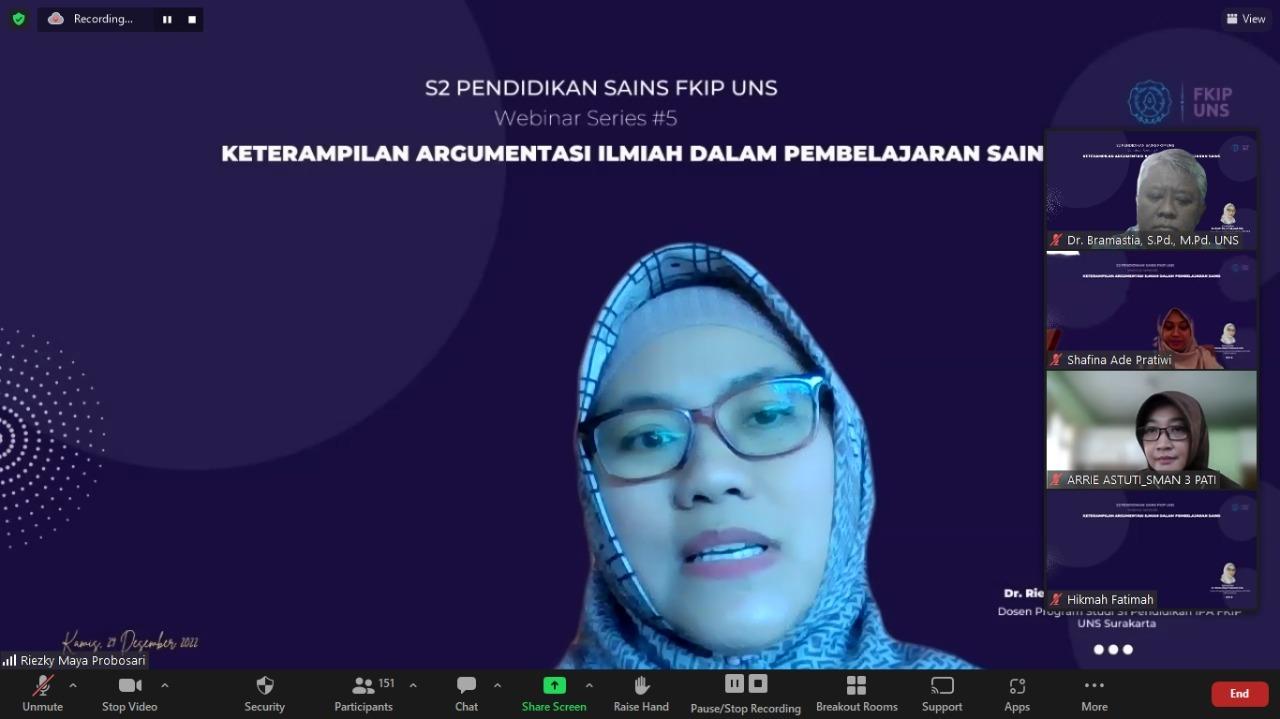
Moderated by Shafina Ade Pratiwi who is a Student of the Science Education Masters Program in FKIP UNS, this webinar presented a guest speaker, namely Dr. Riezky Maya Probosari, M.Sc. He is a Lecturer in the Science Education Study Program, at FKIP UNS. He presented material entitled “Developing Arguing Skills in Learning Science: Planning and Implementation”
. how a phenomenon occurs, but also how to explain it and how to argue or implicate it in the future. He then explains some of the meanings of the argumentation.
“Argumentation is part of knowledge that should be taught or implications for the curriculum and one way to help students understand knowledge and how things are taught. Argumentation is also closely related to how to convince other people, generally it is formally represented in oral or written forms,” explained Dr. Riezky.
Dr. Riezky also believes that currently teachers are still experiencing difficulties in teaching argumentation in class. According to the data he described, these various difficulties included limited time (35.3%), obstacles in determining appropriate learning methods (28.3%), low motivation to argue with students (27.2%), lack of knowledge about arguments (23.2%), unsupportive environmental conditions (11.8%), and insufficient resources (8.6%).
At the end of his presentation, he emphasized that the argument framework analysis differs from one field to another. The argument framework in the field of law is certainly different from that in the field of education. Argument frameworks that can be used in the field of education include dialectical frameworks, namely reasoning based on rules with the context of dialogue, and pragmatic frameworks, namely arguments are considered as types of discourse so that reasoning is based on discourse criteria of reasonable arguments from propositions with opinion status.
Then, he also explained the categorization of argumentation skill levels which consisted of 5 levels, examples of student arguments, as well as the stages of stimulation and development of argumentation skills in class. After the material presented was finished, the activity continued with a question and answer session and ended with a joint documentation session.
Public Relations of FKIP
Reporter: Rosantika Utami
Editor: Aulia Anjani
https://fkip.uns.ac.id/
https://instagram.com/fkipuns.official/
#fkipuns
#fkipbagus
#uns
#unsbisa
