
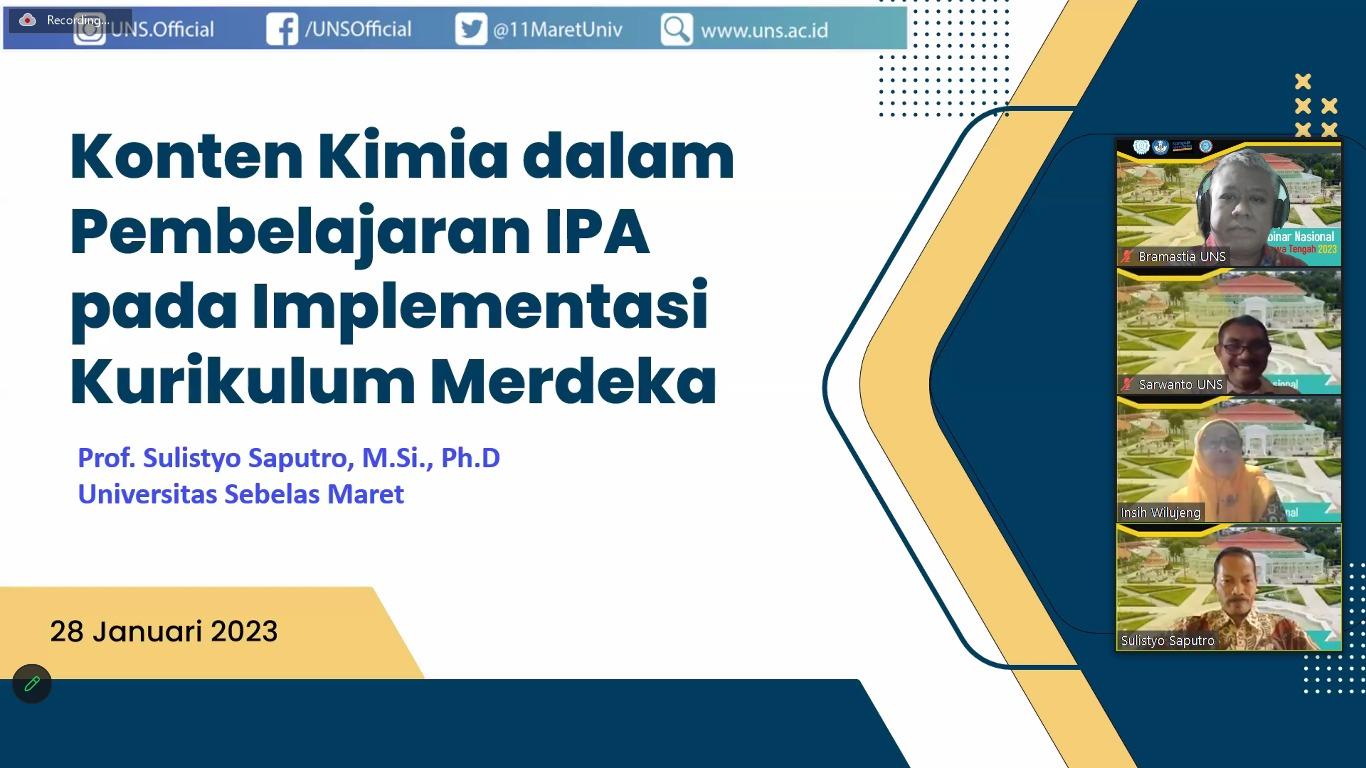
FKIP – Association of Indonesian Science Educators (PPII) Central Java in collaboration with the Science Education Masters Program in the Teaching and Education Faculty (FKIP) Sebelas Maret University (UNS) Surakarta held a Central Java PPII National Webinar on Saturday (28/1/2023) ). The webinar was held online through the Zoom Meeting application and was attended by more than 150 participants.
This webinar carries the theme “Preparation of Science Study Programs to Face the Implementation of the Independent Curriculum (Scientific Substance and Learning)”. The participants were very enthusiastic about observing the scientific and learning substance in preparing the Science Study Program to face the implementation of the independent curriculum.
The opening of the national webinar event was attended by the Central Java PPII Coordinator, Dr. Sarwanto, S.Pd, M.Sc., and Secretary General of the PPII Center, Prof. Dr. Parmin, M.Pd. As for the national webinar, the Head of Natural Science Education (IPA) Study Program, FKIP UNS, Prof. Sulistyo Saputro, M.Sc., Ph.D., and Head of the Yogyakarta State University (UNY) Science Education S-3 Study Program, Prof. Dr. Insih Wilujeng, M.Pd.

Prof. Parmin said that actually the existence of PPII really helped the government in the process of improving the quality of education.
“The existence of PPII is very helpful for the government (in this case, the Ministry of Education and Culture) in the process of improving the quality of education. Apart from that, this national webinar is also a form of central commitment from PPII management, which will support activities in the region by utilizing sources from PPII itself. So far, the role of PPII has always been principled from PPII to PPII itself,” explained Prof. Parmin.
Prof. Sulistyo Saputro as the guest speaker delivered material on “Chemical Content in Science Learning on the Implementation of the Independent Curriculum”. On that occasion, he explained that the government only sets the final goal per phase and the time it takes for the education unit to be free to determine the strategy to achieve that goal.
“Educational units have the discretion to determine strategies and ways or pathways to achieve them. The use of the Learning Outcomes phase in Learning Planning includes flexible learning, learning that is in accordance with the readiness of students, and the development of collaborative learning plans,” explained Prof. Sulistyo.
The strategy for compiling learning objectives in an adequate Flow of Learning Objectives (ATP) by paying attention to the competencies and material to be achieved in the Learning Outcomes (CP). Formulation of learning objectives by considering the competence and scope of the material. In addition, there are efforts to ensure that the main competencies contained in the CP are achieved.
Other efforts include considering a load of lesson hours used to achieve learning objectives so that they are aligned with the CP load on subjects and finally arranging learning goals in a linear manner from the beginning of the phase to the end of the step.
“In preparing the flow, pay attention to the suitability of learning objectives for the complexity and development of students,” said Prof. Sulistyo.
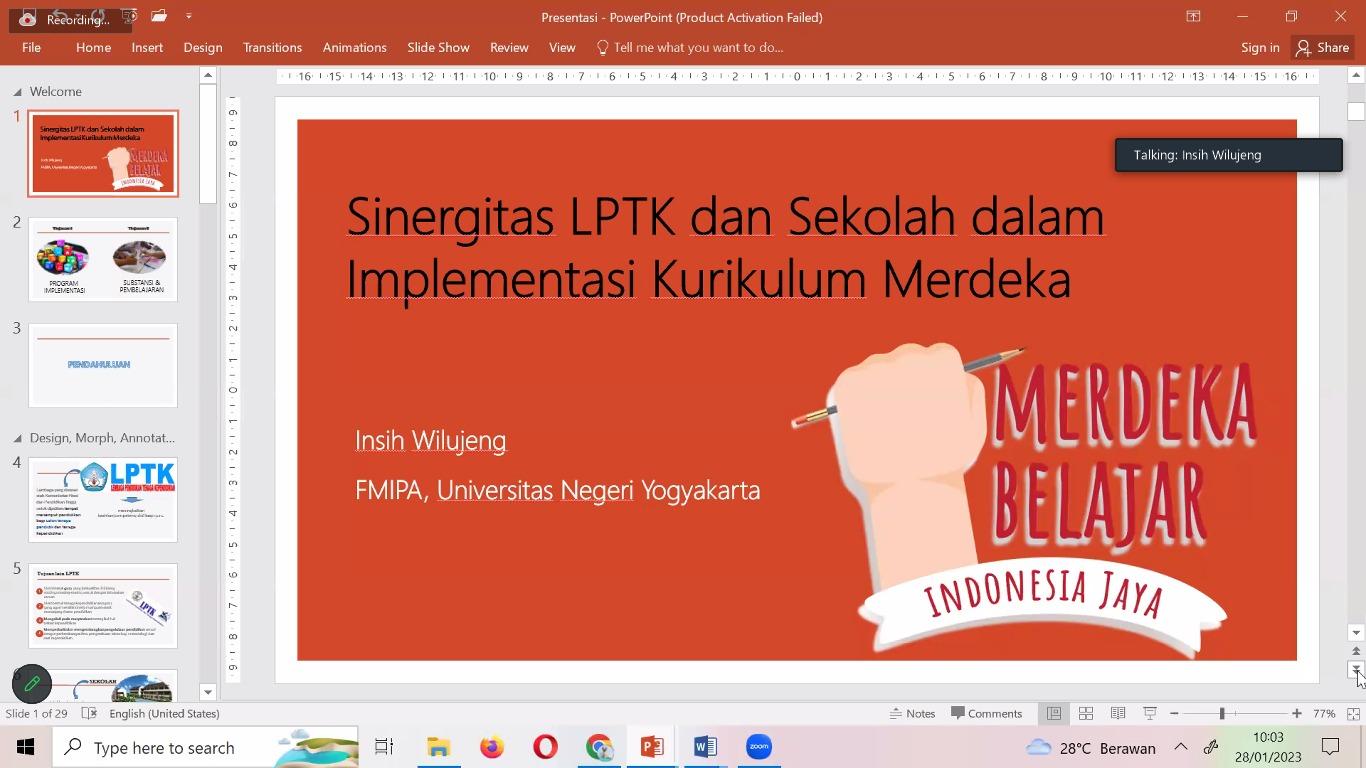
Prof. Insih Wilujeng conveyed the theme “Synergy of TTIs and Schools in the Implementation of the Independent Curriculum”. This topic of discussion considers the implementation program and review of substance and learning. Merdeka Learning Merdeka Campus (MBKM) currently aims to encourage students to master various sciences that can be useful when entering the world of work.
“The Merdeka Campus provides an opportunity for students to determine the courses they will take. So it is necessary to confirm the MBKM program with the Implementation of the Independent Curriculum (IKM),” explained Prof. Insih.
Public Relations FKIP
Reporter: Rosantika Utami
Editor: Budi Suseno
https://fkip.uns.ac.id/
https://instagram.com/fkipuns.official/
#fkipuns
#fkipbagus
#uns
#unsbisa
