
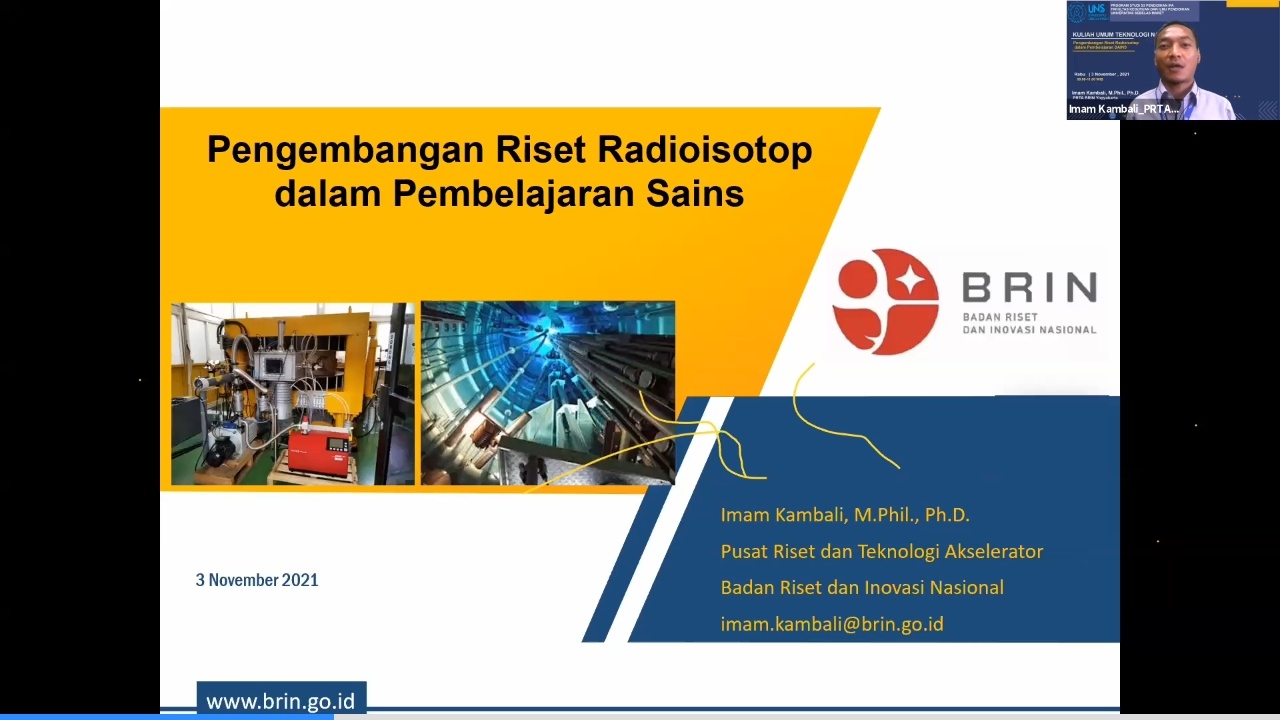
FKIP – Doctoral Degree of Natural Science Education Study Program Faculty of Teacher Training and Education (FKIP) Sebelas Maret University (UNS) Surakarta held a Nano Technology Public Lecture on Wednesday (3/11). With the theme “Development of Radioisotope Research in SCIENCE learning”, the public lecture was held online through the Zoom Meeting application.
In his speech, Prof. Slamet Subiyantoro, M.Sc. as the Deputy Dean for Academic, Research, and Student Affairs FKIP UNS explained that FKIP students must enrich themselves with the knowledge that they can develop as research material to develop teaching materials.

“Indeed, we are in the same faculty of teaching and education, but substantially we must enrich ourselves with content that we can develop. We use this as research material to enrich and develop teaching materials that we will transform for our students. Therefore, the framework of teacher training with your educational knowledge will not be sufficient if it is not equipped with scientific knowledge,” explained Prof. Slamet
The public lecture presented one resource person, namely Imam Kambali, M.Phil., Ph.D. He is an Associate Researcher of the Accelerator Science and Technology Center (PSTA) of the National Research and Innovation Agency (BRIN) Yogyakarta. He explained material ranging from the definition and benefits of radioisotopes, research on radioisotope production based on nuclear reactors, research on cyclotron-based radioisotope production, nuclear reactions in radioisotope production, radioisotope production parameters, benefits of radioisotopes in industry, agriculture, and space, to recommendations related to research development. radioisotope in science learning.
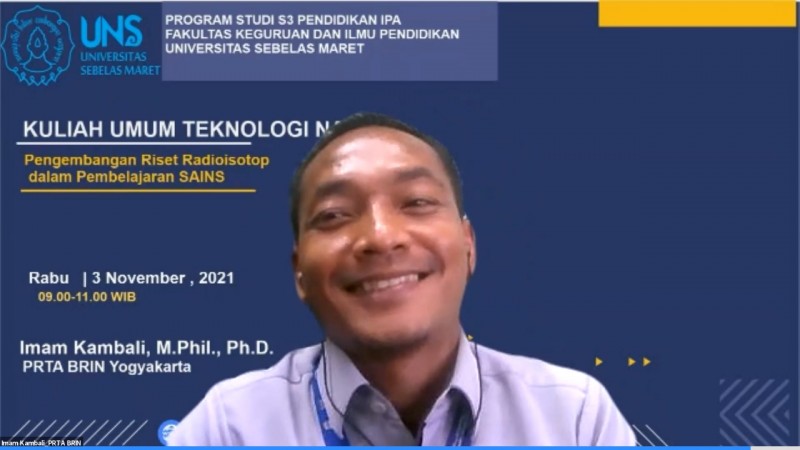
Imam explained that nuclear applications are very broad, not only for making nuclear bombs. In addition, he also explained that in the development of radioisotope research there are two main things, namely research and production technology and research and utilization.
“Some of our society, when they hear the word nuclear, will think of nuclear bombs that have a very extraordinary impact, such as in Hiroshima and Nagasaki. That is only a small part of nuclear applications. Nuclear has a very broad application, both for power generation. , tools in the world of health, industry, agriculture, and even in outer space. Regarding the development of radioisotope research, there are two main things, namely research and production technology as well as research and utilization, “explained Imam.
At the end of his presentation, Imam recommended three things related to the development of radioisotopes in science learning. First, universities are encouraged to conduct courses related to radioisotope research and applications. Second, students and lecturers are encouraged to collaborate with researchers at BRIN regarding radioisotope research. Third, students and lecturers are encouraged to collaborate with PRTA BRINregarding accelerator research, nuclear reactor and accelerator practicum, internships, visits, etc.
Reporter: Rosantika Utami
Editor: Aulia Anjani
https://fkip.uns.ac.id/
https://www.instagram.com/fkipuns.official/
#fkipuns
#fkipbagus
#uns
#universitassebelasmaret
#unsbisa
