
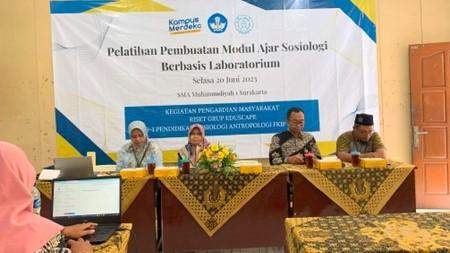

FKIP – The Eduscape Research Group from the Sociology Anthropology Education Study Program, Faculty of Teacher Training and Education (FKIP) Sebelas Maret University (UNS) Surakarta in partnership with the Sociology Subject Teacher Conference (MGMP) Surakarta City held a community service activity with the theme Module Preparation Training Laboratory-based Sociology Teaching. The training was held offline on Tuesday (20/6/2023) at Muhammadiyah 1 SMA Surakarta.
Implementation of UNS Research and Community Service (P2M) activities with the Research Group Grant Service (HGR) scheme was carried out in collaboration with Sociology MGMP Members of Surakarta City to develop laboratory-based teaching modules and identify the urgency of having a Sociology laboratory in an educational institution at the high school level. The activity aims to equalize perceptions about the process of learning sociology in high school, which can be explored in the concept of a sociology laboratory.
The Laboratory-based Teaching Module Preparation Training was opened with remarks from Suratman, S.Pd.I as Deputy Principal for Student Affairs at SMA Muhammadiyah 1 Surakarta City. Then it was continued by Bahrudin Akhmad, S. Sos., M. Pd as Chair of the Surakarta City Sociology MGMP.
The continued speech was delivered by Dr. Siany Indria Liestyasari, S.Ant., M.Hum as Chair of the Eduscape Research Group. All members of the Eduscape Research Group, Sociology Anthropology Education Study Program, FKIP UNS and members of the Surakarta City Sociology MGMP attended the activity.
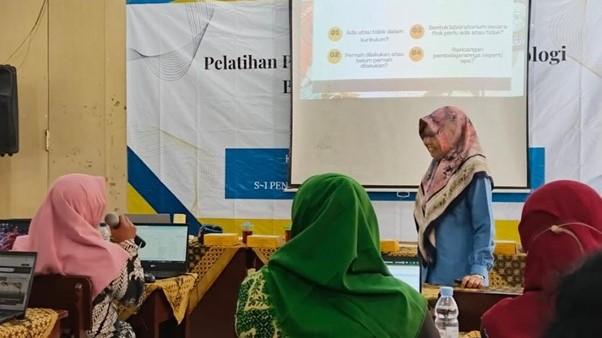
The initial process of the core activities begins with the presentation of material by Dr. Atik Catur Budiarti, S.Sos., M.A., regarding the importance of laboratory-based sociology learning. This was followed by discussions, questions, and answers regarding the relationship between the sociology laboratory and the curriculum, the practical experiences of sociology laboratory-based learning by teachers so far, the form and concept of the sociology laboratory, and the teaching plans to be prepared. The discussion results aim to brainstorm perceptions between teachers regarding teaching modules and the design of sociology laboratory-based learning activities.
In the follow-up session after the presentation of the material and the discussion, participants had one perception about the importance of a sociology laboratory in schools. Then a group formation process was carried out between members of the Surakarta City Sociology MGMP, totaling 6 groups. In the process, with the help of flipchart media, each group is tasked with discussing and elaborating the common perception of the concept of Laboratory-based Sociology learning into four phases.
In the first phase, the teacher describes the concept of learning. In the second phase, the teacher is expected to be able to represent a form of laboratory-based sociology learning activity. In the third phase, the teacher is expected to be able to describe the stages of laboratory-based sociology learning activities. In the fourth stage, the teacher can determine laboratory-based sociology learning products.
After the group finished discussing, an exhibition of the results of the design of laboratory-based sociology teaching modules was carried out through flipcharts which were carried out directly. Service members, through the work displayed, can now ask questions, discuss to provide input, or adopt ideas between groups so that they can be applied in the design of their respective sociology laboratories.
It is hoped that the training process for sociology laboratory-based teaching modules can be applied by teachers on an ongoing basis to provide awareness for sociology teachers regarding the importance of planning complex learning stages in developing physical laboratory-based sociology learning in schools and community-based.
PUBLIC RELATION FKIP
Reporter: Rosantika Utami
Editor: Budi Suseno
https://fkip.uns.ac.id/
https://instagram.com/fkipuns.official/
#fkipuns
#fkipbagus
#uns
#unsbisa
