
FKIP – Local wisdom has an extraordinary treasure such as Social and philosophical that can be applied and even become a guide to behavior in the nation and state apart from the values ideological ideology of religion.
It was conveyed by Dr. Djono, Deputy Dean of Planning, Business Cooperation, and Information, at the opening of the IV BIPA International Conference on Saturday (18/9/2021). The event, which was held through a zoom meeting and the YouTube channel of the Association of Indonesian Language and Literature Study Programs, took the theme of BIPA and Local Wisdom.
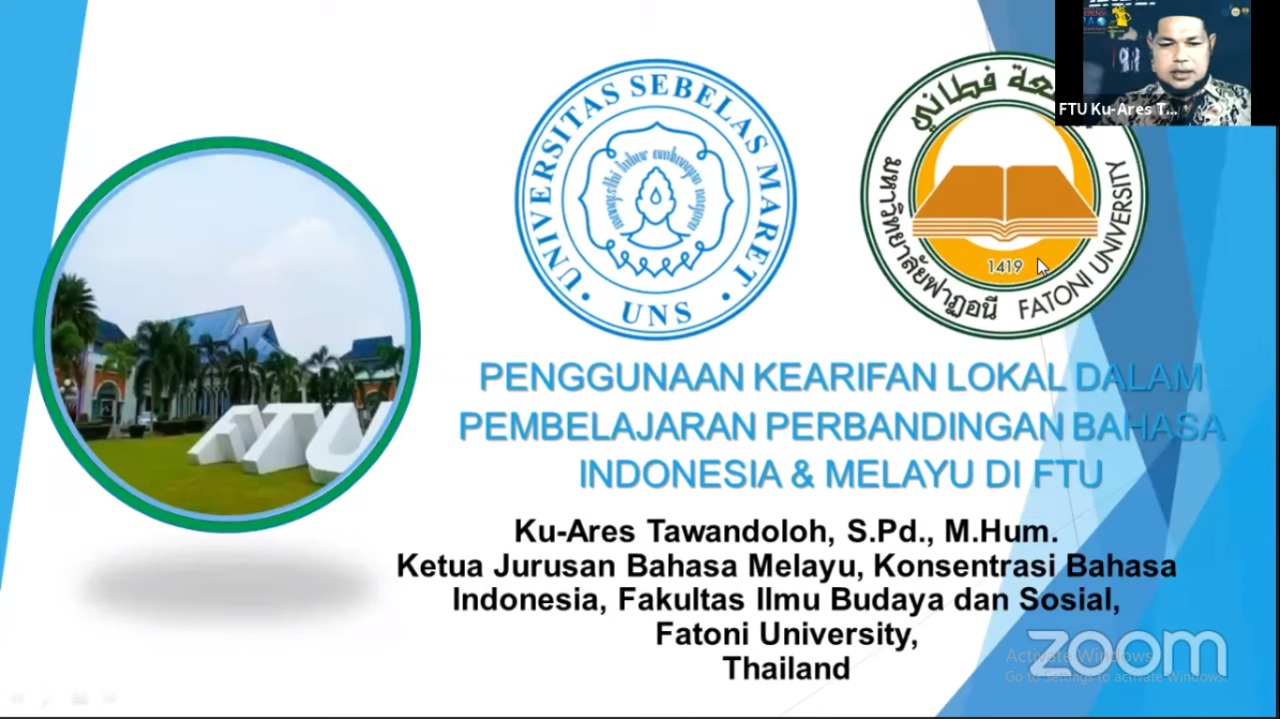
The IV BIPA International Conference is a form of collaboration between Sebelas Maret University and Fatoni University Thailand. The form of a series of collaborations includes joint teaching, research, and competitions at the Southeast Asian level. This collaboration is expected to be a form of university internationalization, especially in the Indonesian language. This activity was initiated by the Indonesian Language and Literature Education Study Program, Faculty of Teacher Training and Education (FKIP) Universitas Sebelas Maret (UNS) Surakarta which is held once a year.
This conference presented several speakers, including Ku-Ares Tawandoloh, S.Pd., M.Hum (Fatoni University Thailand), Islahuddin, SS, MA (Fatoni University Thailand), Sumaiyah Menjamin, M.Hum (Fatoni University Thailand), Wati Istanti (Semarang State University), Dr. Memet Sudaryanto, M.Pd (General Sudirman University), Chafit Ulya, M.Pd (Sebelas Maret University), and Titi Setiyoningsih, M.Pd (Sebelas Maret University).
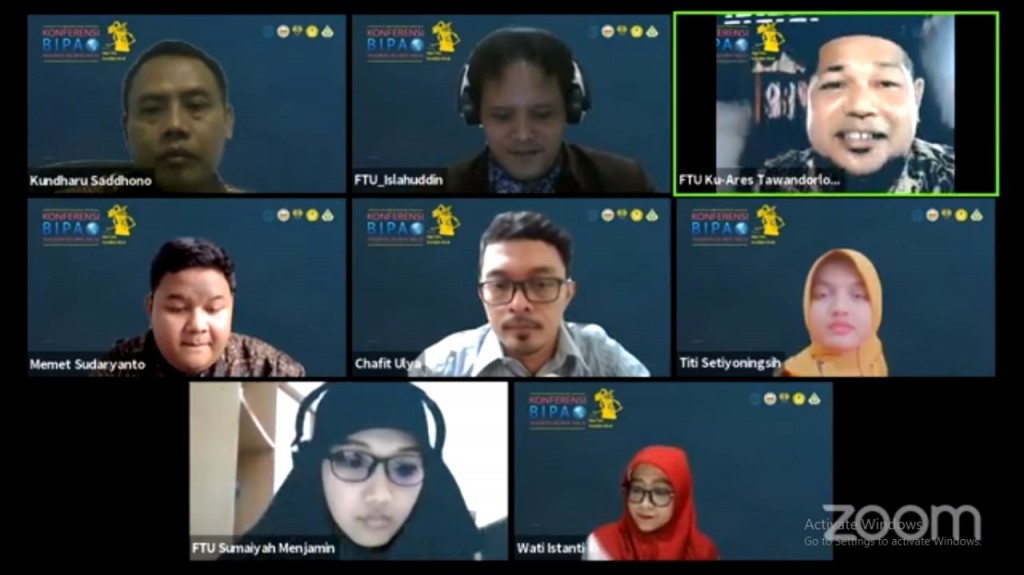
According to Dr. Memet Sudaryanto, Jenderal Soedirman University, Indonesian for Foreign Speakers (BIPA) is a vehicle for introducing Indonesian culture and various activities in it. The activities are in the form of artistic and cultural products, such as performing arts that are shown in real terms through various media.
“Cultural, ethnic, and regional differences in Indonesia provide great opportunities for Indonesia in developing multi-dimensional, multimedia, and multifunctional teaching materials,” he said.
The development of multimedia-based learning makes it easier for foreign speakers to continue to be interactive with the conditions and culture in Indonesia that continues to develop. So that indirectly foreign speakers are required to know the meaning, intent, and purpose and be able to convey it back with the language mastered.
He added that the obstacle in learning a language is when students are faced with topics that are not mastered. It means that learning a language that is not contextual makes learning a language seem difficult.
“One of the most prominent and the most problematic is sometimes like when we learn a foreign language or English, we are faced with topics that we do not master, for example as humanities we have to study science topics such as microbiology, nuclear, anthropology, astronomy. etc. it becomes one of the obstacles in learning the language,” he added.
Wati Istanti, Semarang State University, added that the current BIPA is not only for foreigners or Darmasiswa programs but also for Indonesians who cannot speak Indonesian.
“It turns out that yesterday from Singapore and Kinabalu there were many Indonesian migrants who went abroad but could not speak Indonesian properly,” he explained.
In addition, concerning learning outcomes, BIPA also has achievements that all foreign students must pay attention to, namely how to provide attitudes.
“In the Indonesian national qualification framework, there are also graduate learning outcomes that all foreign students must be skilled at in Indonesian, they also know about the Indonesian language, but there are things that are very important and this is a highlight that is how we also provide attitudes,” he added.
Reporter: Muhammad Muzaqqi
Editor: Aulia Anjani
https://fkip.uns.ac.id/
https://www.instagram.com/fkipuns.official/
#fkipuns
#fkipbagus
#uns
#universitassebelasmaret
#unsbisa
